

Case Studies
Mission Complete: Developing an Application for Farmers in Bolivia
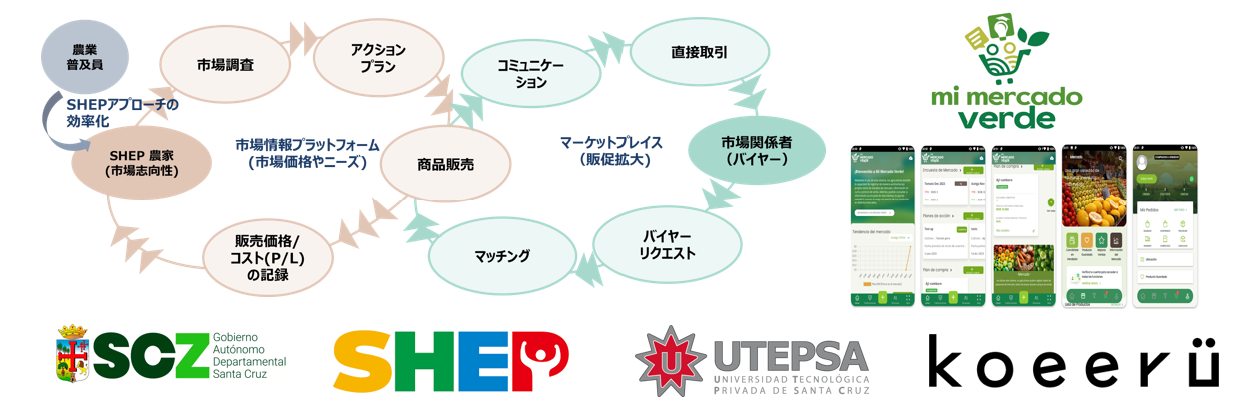
Koeeru Inc., in collaboration with the Departmental Agricultural Service of Santa Cruz (SEDACRUZ) and the Private Technological University of Santa Cruz (UTEPSA), and with the financial support of Japan’s Ministry of Economy, Trade, and Industry, is proud to announce the completion of the proof-of-concept project Mi Mercado Verde. This project, centered around developing an application for farmers and buyers in the Department of Santa Cruz, aims to address problems in the following three areas: (1) transparency in agricultural market pricing, (2) creating a marketplace between small-hold farmers and buyers, and (3) streamlining agricultural extension work.
Project Background
While agriculture accounts for only 11% of Bolivia’s GDP, almost 74% of the country’s agricultural production is centered in Santa Cruz Department. However, there are a number of challenges to the sector, including unstable production infrastructure, uneven standards and quality of products, a lack of collection, storage, and processing facilities, inefficient distribution systems, underdeveloped sales channels, and insufficient market data.
To address the above issues, the Japan International Cooperation Agency (JICA) has been promoting, with SEDACRUZ and three other departments, an agricultural extension project in the country. This extension project incorporates a market-oriented agricultural promotion (SHEP) approach in order to help farmers grow to sell instead of grow and sell.
Challenges Faced by Each Actor
Farmer Challenges
Because they lack access to market information or are not in the habit of using such information, local farmers typically sell at the asking prices of intermediaries or wholesalers. Without access to market price data and needs however, they are unable to formulate plans based on what the market truly needs or find sales outlets to sell their products.
Marketplace Buyer Challenges
Marketplace buyers face unstable supplies due to commodity losses, weather conditions, road closures, etc. They also lack farm information (location, volume, cultivation methods, shipping times, etc.) and therefore lack the opportunity to match market-oriented farmers with market needs.
Agricultural Extension Worker Challenges
In regards to agricultural extension work, there is currently no mechanism linking training to sales promotion activities. Additionally, there is little data available on local markets. (For example, there is no data on the gap between what farmers want to sell their goods for and what they actually sell their good for.) As such, there is currently no efficient way to manage an agricultural extension project based upon the SHEP approach, which takes into consideration things like market research, action plan development, farmer-buyer matching, and the recording of P/L numbers.
Solutions Sought
To solve the above challenges, Koeeru narrowed down the needed solutions into three broad categories. (1) transparent market information; (2) a marketplace that supports communication, seller-buyer matching, and sales; and (3) a platform that can optimize the effectiveness of the SHEP approach. While existing apps or marketplaces might individually solve one or two of these, there was no app that could comprehensively cover all.

Solution Overview
For this project we decided to build a prototype application that combined new development with localization and customization of one of our existing applications developed for the Tanzania SHEP Project as part of JICA’s Africa Open Innovation project in 2021.

Using design thinking and agile development, we broke the project down into the following steps:
- Design Research: Through interviews and prototyping with industry, academia, and government partners, as well as with actual users including farmers, marketplace buyers, and agricultural extension officers, we sought to understand each user’s current situation, the challenges they faced, and their ideal system.
- Defining the Requirements: Based on the above design research, we defined the system requirements, including UI/UX improvements, new functions in need of development, and localization.
- Application Development: Using the requirements, we created a prototype of Mi Mercado Verde.
- Proof of Concept Testing: The completed prototype was then tested by actual users to obtain feedback on its functionality, usability, and future features and improvements.
- Prototype Completion: Based on the feedback in step 4, we reviewed the design requirements and made changes to the application, thus allowing us to launch the first version of Mi Mercado Verde.
Results
As a result of the above process, Koeeru was able to develop a solution that could solve the assorted needs of each user. In general, users gave the project high praise, with most scoring it at 8 out of 10 or higher. In particular, functions related to seller-buyer matching and finding new trading partners were rated especially high.
In the next phase of the project, Koeeru plans to continue our industry-academia-governmental collaboration with the aim of Mi Mercado Verdi being used as an official tool of such agricultural extension projects.
Future Prospects
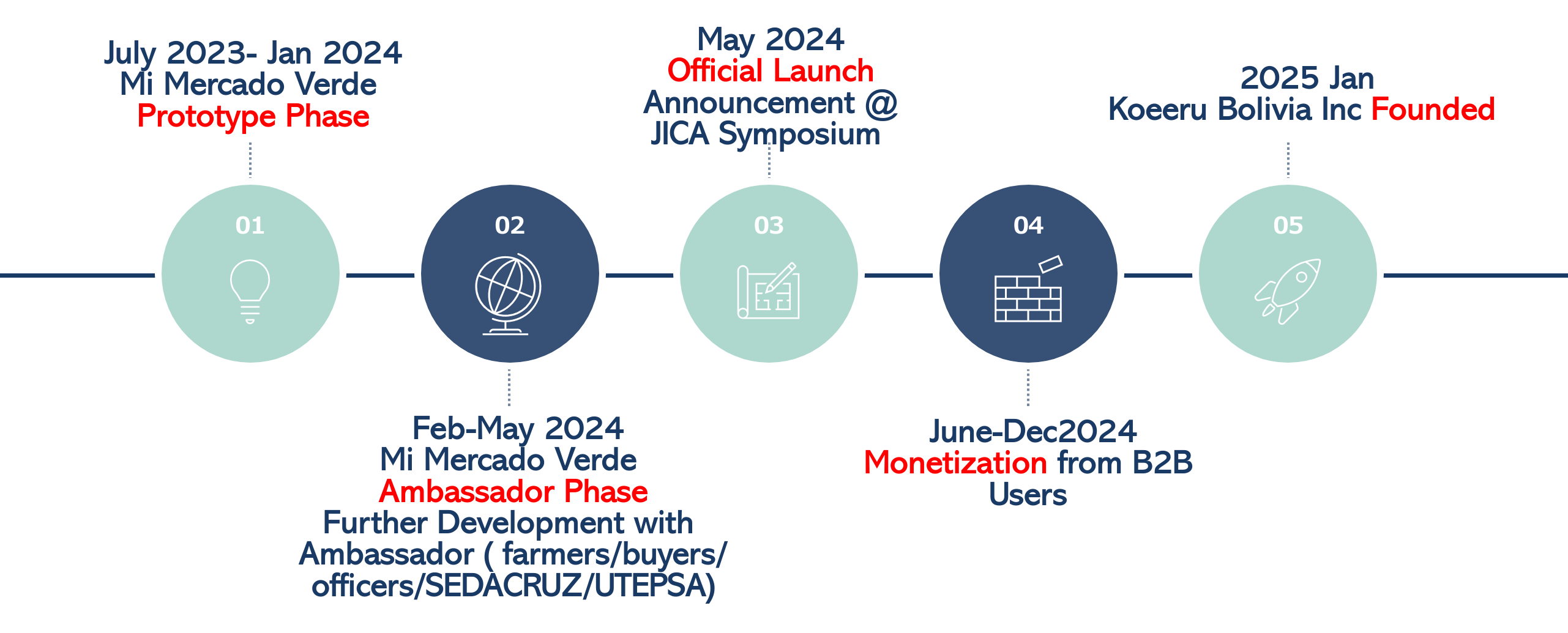
After the completion of this proof-of-concept phase, the second phase of the project will focus on having Mi Mercado Verdi serve as an official tool for projects utilizing the SHEP approach, while also continuing to expand the system’s user base through early adopters, with its official release aimed for for June of this year.

Picture from the wrap-up meeting of the project, with industrial, academic, and governmental partners, as well as the Japanese consulate ambassador present!
- Tag Cloud
- Global Research顧客満足度調査Data PlatformAgricultural DXe-CommerceBoliviaZero Party DataAfrica AgriTechInterviewStartup InnovationJICAJ PartnersTanzaniaKoeeru TrendVietnamSmart CityCEO BlogGlobal expansionTop NewsSocial EnterpriseCustomer ExperienceTop Case StudiesArticleCareersTop ArticleSurvey PanelTourism DXEmployee InterviewOpen InnovationKoeeru GlobalInbound TourismMarket ResearchGlobal Research Case StudyNewsJETROTourismHotel Marketing
Related Articles
-

Case Studies
The Nagano Tourism Organization Has Selected Koeeru for the Development and Running of Their New Customer Data Platform System
-

Case Studies
Koeeru’s Market-Oriented Agriculture Platform Selected for Development by JICA’s Open Africa Innovation Challenge
-

Case Studies
Customer Interview: Bringing Cross-Border E-Commerce Closer with Zero-Party Data
-

Case Studies
Visualizing the Voices of Customers: from e-Commerce to Retail Locations
Receive Updates to your Inbox!
Sign up for our newletter to receive timely updates, how-to tips, and invitations to webinars and events.